How Tall a Bichon Frise Stands
A Bichon Frise can look taller or shorter than expected beneath all that fluffy coat, and a quick glance often isn’t enough to tell whether your dog is within the usual range. The key is measuring at the shoulders, not to the top of the head or curls. This guide explains the standard height, how to measure accurately, and what height does—and doesn’t—tell you about your dog’s health.
How tall is a Bichon Frise?
The usual height range
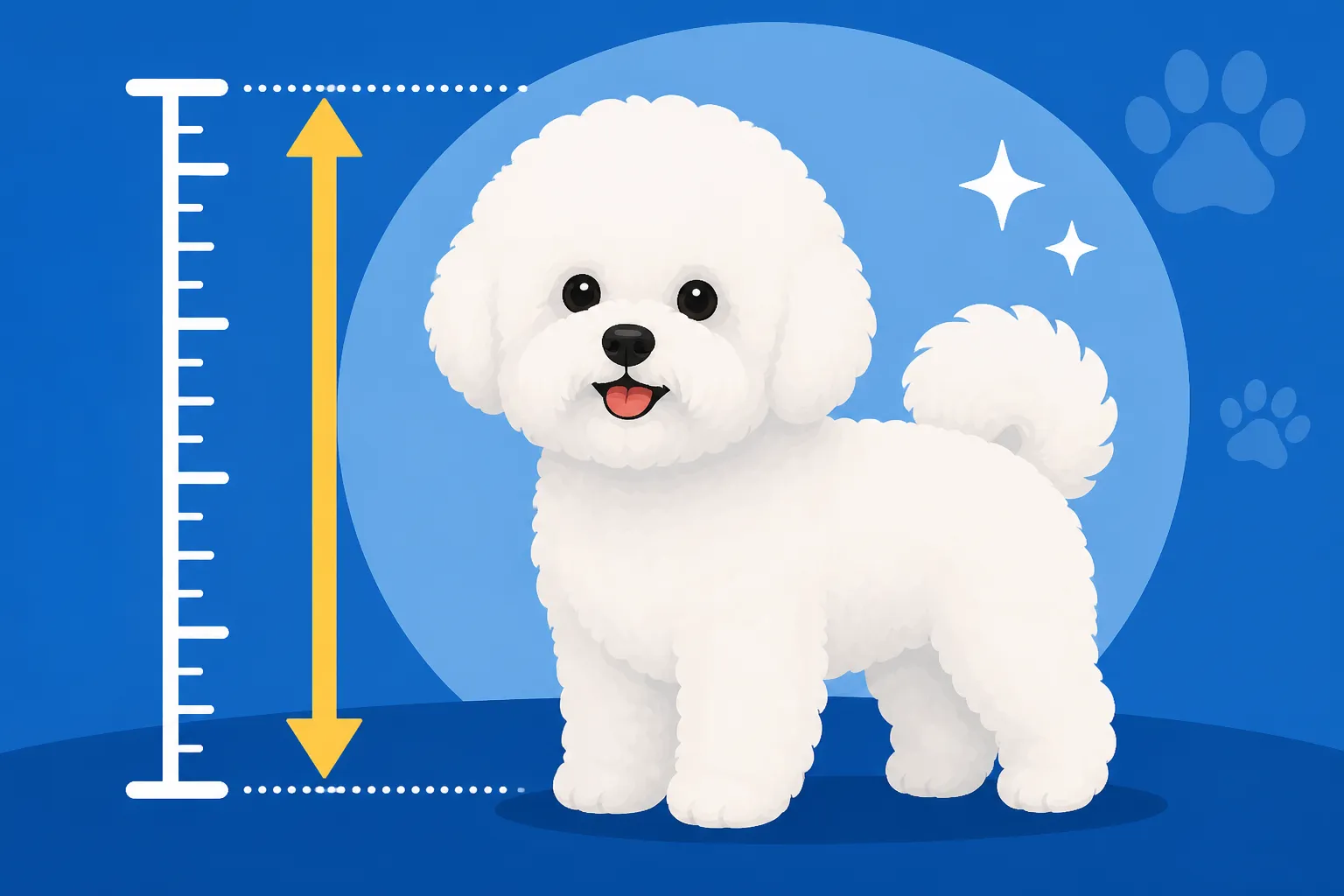
An adult Bichon Frise typically stands about 9.5 to 11.5 inches tall at the withers. The withers are the highest point of the shoulders, where the neck meets the back. That measurement is the useful one for comparing a dog with the breed’s expected size.
Some healthy Bichons may fall a little outside that range. A small difference does not automatically mean anything is wrong: individual dogs vary, and measurements can be thrown off by posture, coat, or an uncooperative measuring session. If your dog seems notably shorter or taller than expected, your veterinarian can assess overall growth and body condition rather than judging by height alone.
Height is only one part of a Bichon’s size. A dog’s frame, weight, proportions, and condition matter too. For a fuller picture, see How Big a Bichon Frise Gets and What a Bichon Frise Actually Weighs.
What “at the withers” means in practice
It’s easy to measure the wrong point. The top of a Bichon’s rounded head may sit well above the shoulder line, while the coat can make the outline appear taller or broader than the body underneath. Breed height is not measured to the ears, head, or highest puff of hair.
Picture your dog standing squarely on a level floor. The withers are just behind the base of the neck, where the shoulder blades meet. If you’re comparing measurements from different sources, check that they refer to the withers; a measurement taken to the head won’t be comparable.
| Measurement | What it describes | Useful for comparing breed height? |
|---|---|---|
| Height at the withers | Floor to the highest point of the shoulders | Yes |
| Height to the top of the head | Floor to the head, ears, or coat | No |
| Body length | Front of the chest to the rear of the body | No |
| Weight | How heavy the dog is | No, but useful alongside height |
How to measure your Bichon Frise at home
A simple measuring method
For a reasonably accurate reading, use a level surface, a rigid ruler or measuring stick, and a calm moment. A second person can help keep your dog standing naturally instead of leaning toward you or sitting down halfway through. Try not to measure immediately after energetic play, when your dog may be panting, wiggling, or reluctant to stand still.
- Let your dog stand on a level floor with all four paws underneath the body.
- Find the highest point of the shoulders at the withers.
- Hold a ruler or measuring stick vertically beside your dog, keeping it perpendicular to the floor.
- Use a level object, such as a book, to mark the height from the withers to the ruler.
- Record the measurement and repeat once to see whether you get a similar result.
Avoid pressing down on the coat or trying to measure through a thick curl by eye. You’re looking for the body’s shoulder point, not the top of the hair. If your dog is uncomfortable or keeps moving, stop and try again later rather than turning measuring into a wrestling match.
Common measuring mistakes
A frequent mistake is measuring from the floor to the highest part of the head. That can make a Bichon seem taller than the breed measurement would indicate. Another is measuring while the dog is sitting or standing with the back legs tucked under; that changes posture and can make it harder to identify the shoulder line.
The tape measure can also mislead if it bends around the dog or runs diagonally. Height is a straight vertical measurement, not the distance along the body. If you’re uncertain about the result, ask your veterinarian to measure your dog during a routine visit. It’s also worth checking whether an older measurement was taken with the dog standing naturally and at the withers before treating the difference as real growth or shrinkage.
How height changes as a Bichon Frise grows
Puppy growth and adult height
Puppies don’t reach adult height all at once. They grow in stages, and a young Bichon can look leggy or out of proportion before the rest of the body catches up. A single puppy measurement won’t reliably predict exact adult height, especially if the puppy is still growing.
Your veterinarian can help assess growth over time by considering age, weight, body condition, and general development. Regular measurements may be interesting to record, but they’re not a substitute for health checks. For more on growth timing and family traits, read The Age a Bichon Frise Reaches Full Size and Whether Parent Weights Predict a Bichon Frise's Size.
If you have a puppy and notice a sudden change in appetite, energy, gait, or growth, mention it to your vet rather than trying to explain it through height alone. A small puppy is not automatically unhealthy, and a taller puppy is not automatically destined to be unusually large. Family size may offer clues, but it cannot promise a precise adult measurement.
Adult dogs and changes over time
Once a Bichon has finished growing, its height should be fairly stable. Changes in how tall a dog appears are often caused by posture, coat length, grooming style, or changes in body condition—not an actual change in the bones. A full, rounded trim can give a dog a larger silhouette, while a shorter clip may make the same dog look more compact.
An older dog may stand differently if it has stiffness or discomfort, which can make a home measurement less consistent. If your dog begins to hunch, seems reluctant to stand, limps, or has trouble getting up, focus on those changes rather than repeatedly measuring height. A vet can check whether pain, mobility, or another issue is affecting posture.
Does height tell you whether a Bichon is healthy?
Small or tall does not automatically mean unhealthy
A Bichon that is slightly below or above the typical height range may still be healthy. Height alone does not tell you whether a dog is at an appropriate weight, has a healthy body condition, or is moving comfortably. A compact dog can be overweight, while a taller dog may be lean and fit.
The more useful question is how your dog’s body and behavior fit together. Your vet can assess body condition, muscle, movement, and development alongside height. If you’re concerned that a particularly small dog may have health or welfare issues, Whether the Smallest Bichon Frises Are Healthy offers additional context. For the opposite concern, Whether a Bichon Frise Is Sturdier Than It Looks discusses why a small-looking breed should not be judged by appearance alone.
Be cautious of labels such as “miniature” when they’re used to promise a special size. A healthy Bichon is not defined by being as small as possible. Extremely small size can be a reason to ask thoughtful questions about breeding, health history, and veterinary care, rather than a feature to pursue without context. See Whether a Miniature Bichon Frise Is Real for more on that distinction.
Height and everyday equipment
Height can help when you’re planning for a dog’s space, but it is not enough to choose every item. A crate should let your dog stand naturally, turn around, and lie down comfortably; check the dog’s actual measurements and the manufacturer’s sizing guidance. A carrier has its own fit requirements, so compare its dimensions with your dog rather than relying on breed name alone.
Harnesses are an especially common source of confusion. Two dogs with the same height can have different chest measurements and body shapes, so measure the chest and neck as directed by the harness maker. If comparing options on Chewy, use the sizing information for each individual item rather than assuming that a “small” label means the same fit across brands. Chewy listings may also provide product dimensions, which can help you compare space before purchasing.
For another harness or carrier, repeat the measurements instead of carrying over a size from a previous item. A well-fitting harness should sit securely without restricting movement or rubbing, and you should be able to follow the maker’s fit instructions. Chewy can be one place to compare listed sizing details, but the dog’s measurements—not the breed label—should guide your choice.
If your Bichon is between listed sizes, check the manufacturer’s guidance and consider whether the item is adjustable. Height may be useful for a crate or carrier, but chest girth and neck measurements often matter more for wearable gear. When you’re uncertain, ask the retailer or manufacturer how to measure for that specific item; Chewy’s product information can help you locate the dimensions to compare.
What to remember when checking your dog’s height
Measure from a level floor to the withers while your Bichon stands naturally. Don’t use the head, ears, or top of the coat as the endpoint, and don’t assume that height alone explains weight, health, or equipment fit. The typical adult range is a helpful reference, not a diagnosis or a reason to worry over a small difference.
If your measurement seems unusual, take it again carefully or ask your vet to check it. Focus on your dog’s overall condition, comfort, growth, and movement. Those details give a much more useful picture than a number on its own.
Disclaimer
This article is for general informational purposes only and does not constitute professional advice. Laws, prices and regulations vary by location and change over time. Consult a qualified professional for guidance on your specific situation.