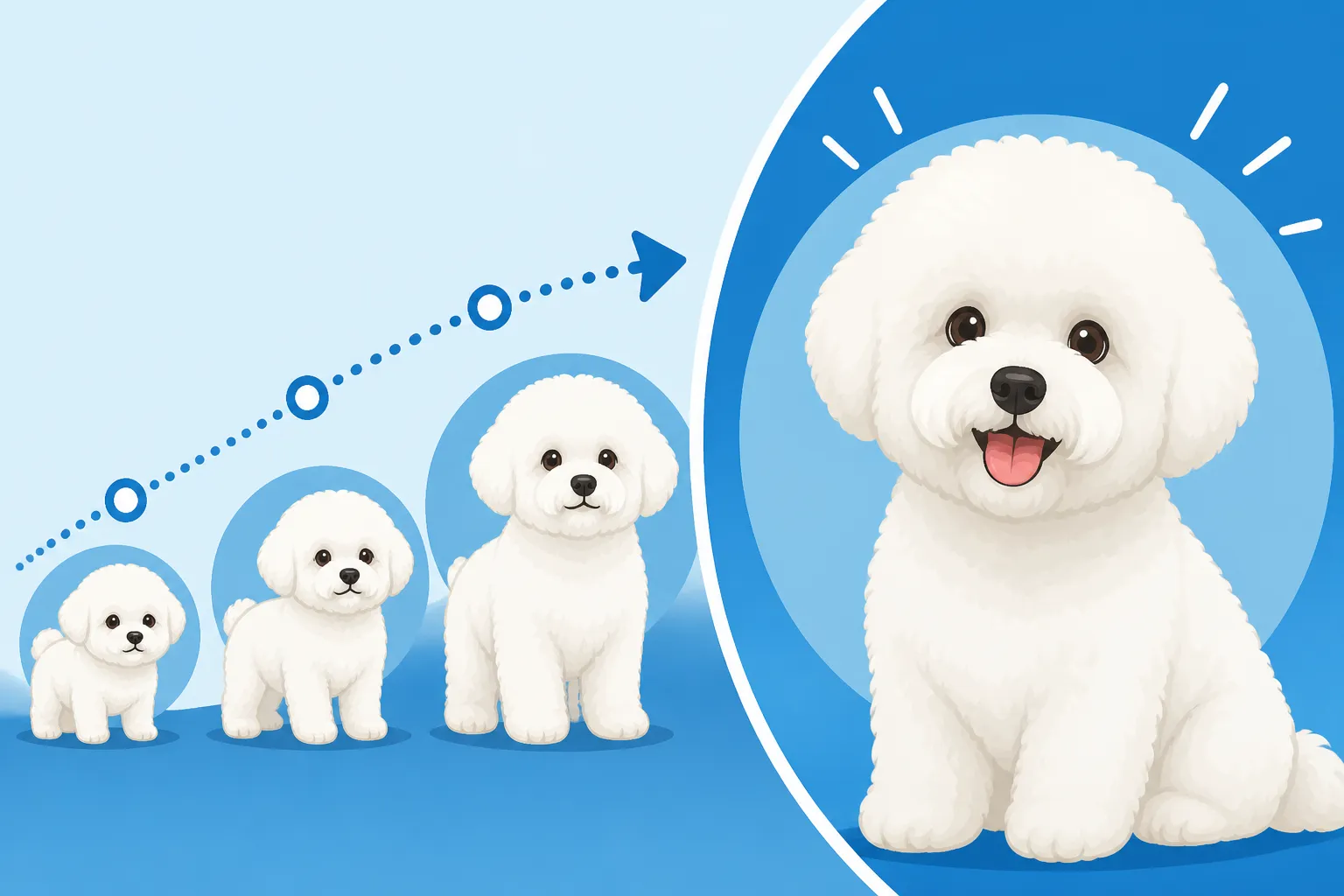
The Age a Bichon Frise Reaches Full Size
A Bichon Frise can look nearly grown while still filling out, and its fluffy coat makes it especially hard to judge by eye. Most reach close to their adult height during puppyhood, but weight and body shape may keep changing for several more months. This guide explains the usual timeline, what influences growth, and how to tell whether your dog is developing as expected.
When a Bichon Frise Reaches Adult Size
Height usually comes first
Most Bichon Frises reach close to their adult height somewhere around six to eight months, though there is no exact birthday when every dog stops growing. A puppy may still gain some height after that, but the changes are usually less noticeable than during the first months of life.
Breed standards describe a small dog, generally around 9.5 to 11.5 inches tall at the shoulder. Your pet’s height may fall a little outside that range and still be healthy. Individual build, sex, family traits, and how height is measured can all affect the number. To measure consistently, have your dog stand naturally on a level surface and measure from the floor to the top of the shoulder, rather than judging from the top of the fluffy head.
It’s easy to mistake coat volume for body size. A freshly groomed Bichon can look compact, while a longer, puffier coat can make the same dog seem broader and taller. For a more reliable sense of growth, pay attention to body condition and occasional measurements rather than comparing photographs taken with different coat lengths. For a broader look at expected proportions, see How Big a Bichon Frise Gets.
Weight and body shape may take longer
A Bichon Frise may continue to gain weight and develop a more adult-looking frame after most of its height growth has slowed. Many are close to their adult weight by around 10 to 12 months, but some continue filling out beyond their first birthday. A common adult weight range is roughly 12 to 18 pounds, although a healthy individual may be smaller or larger.
“Filling out” should mean gradual development, not simply becoming heavier. A young dog may gain muscle and look less puppy-like as its chest and body mature. But rapid weight gain can also be a sign that portions or treats need a second look. You should be able to feel the ribs under a light layer of tissue, without them being sharply visible, and your dog should have a visible waist when viewed from above.
If you’re unsure whether your dog is growing normally, keep a simple record of weight and body condition and discuss it at routine veterinary visits. A single number is rarely as useful as the pattern over time. The guide What an Adult Bichon Frise Weighs can help put your dog’s weight into context without treating the breed average as a strict target.
What Can Affect a Bichon Frise’s Growth
Genetics and family size
A puppy’s parents and close relatives offer useful clues about its likely adult size. If both parents are small, the puppy may also mature on the smaller side; larger parents may have puppies that end up toward the upper end of the usual range. These are clues, not guarantees. Puppies in the same litter can grow at different rates and finish at different sizes.
A breeder may be able to share the parents’ adult weights and how earlier puppies from the same line developed. Even then, estimates should be treated as a rough guide. A puppy’s current weight cannot reliably predict its final size by itself, especially if you do not know its exact age, early nutrition, or family background. For more on the limits of that estimate, see Whether Parent Weights Predict a Bichon Frise's Size.
Nutrition, health, and early development
Good growth depends on a suitable diet, enough food for the puppy’s needs, and general health. Puppy food is formulated for growth, but the right feeding amount depends on the individual dog, the food’s calorie content, and how quickly the puppy is gaining. Follow the food’s feeding guidance as a starting point, then ask your veterinarian to help adjust portions based on body condition.
Avoid trying to make a puppy grow faster by offering extra food or supplements. More food does not make a dog reach its genetically determined adult size sooner; it may instead lead to excess weight. If you compare food labels or feeding information at Chewy, use the package instructions as a starting reference, not as a substitute for advice tailored to your puppy. Your veterinarian can help you decide whether the current diet and portions suit your dog’s age and condition.
Illness, parasites, digestive problems, or difficulty eating can interfere with normal development. A puppy that is not gaining weight, seems unusually tired, has ongoing vomiting or diarrhea, or is falling behind its previous growth pattern should be checked by a veterinarian. These signs do not automatically mean there is a serious problem, but they deserve attention rather than a wait-and-see guess.
Sex and individual variation
Male and female Bichon Frises can differ in size, but the difference is not dependable enough to predict an individual dog’s adult weight. A smaller male can finish lighter than a larger female, for example. Family traits and overall health matter more than sex as a simple rule.
There can also be normal differences in how quickly puppies mature. One Bichon may look lanky for a while, while another from the same litter appears more compact. A temporary pause in visible change does not necessarily mean growth has stopped. The more helpful question is whether the dog is following a steady, healthy pattern and behaving normally.
How to Track Your Bichon Frise’s Growth
Use consistent measurements
A simple log is more useful than trying to remember whether your puppy looked bigger last month. Weigh your dog periodically under similar conditions, such as on the same scale and at a similar time of day. If your puppy is small enough, you can weigh yourself holding the dog and subtract your own weight, though a pet or veterinary scale may give a steadier reading.
Record the date, weight, and any relevant changes, such as a new food, appetite shift, or illness. You do not need to weigh a healthy puppy every day. Frequent checking can create unnecessary worry because small differences may reflect meals, bathroom timing, or scale variation rather than real growth. If you use an online retailer such as Chewy to compare pet scales or food information, check the product details carefully and remember that your veterinary clinic can also weigh your dog during visits.
For size, measure the shoulder height every few weeks rather than every few days. Keep the dog standing squarely on a level floor, and repeat the measurement if the result seems surprising. A wiggly puppy and a soft tape measure can produce a number that looks precise but is not especially reliable.
Judge body condition, not just the number
A healthy weight can look different on two Bichons with different frames. Check the outline of your dog’s body and ask your veterinarian to show you how to assess body condition. In general, the ribs should be easy to feel without being prominent, and there should be a slight waist behind the ribs when viewed from above.
The coat can hide weight changes. Run your hands gently along your dog’s sides rather than relying only on appearance, especially if the coat is long or dense. A groomer’s trim can also make the body look different from one visit to the next, so avoid interpreting every change in silhouette as a change in growth.
If you’re monitoring growth using food portions, count treats and extras as part of the day’s intake. A few small rewards can add up for a little dog. When comparing feeding guidance at Chewy or on a food manufacturer’s packaging, check that you are looking at the correct life stage and food formula; feeding directions can differ between products.
Know when a vet check is sensible
Contact your veterinarian if your puppy loses weight, stops gaining over a period when growth would normally be expected, or has persistent appetite or digestive problems. A sudden change matters more than a single measurement that seems a little above or below a general breed range. Your vet can review the growth record, examine your dog, and decide whether further checks are needed.
It is also worth asking about growth at routine puppy appointments, even if your dog seems well. Those visits let the veterinarian compare weight over time and assess development alongside vaccination, dental, and general health checks. Bring your notes if you have them; they can make the conversation more specific.
What “Full Size” Means for a Bichon Frise
Adult size is not the same as a mature coat
A Bichon Frise’s coat can change how big the dog looks, and coat development may not match the body’s growth timeline. Grooming style, coat length, and the transition from puppy coat to adult coat all influence the outline. A dog can be physically close to adult size while still looking different from one grooming appointment to the next.
That’s why “full size” is best treated as a combination of height, weight, and body development rather than a single visual milestone. Your dog may reach near-adult height first, gain some additional weight later, and continue to look more mature as its coat and proportions change. For background on how the breed’s outline is understood, see The Powder Puff Outline the Bichon Frise Standard Describes.
A practical age-by-age guide
| Approximate age | What you may notice | What to keep in mind |
|---|---|---|
| Two to four months | Rapid changes in height and weight | Feed an appropriate puppy diet and attend scheduled veterinary visits |
| Four to six months | Continued steady growth; puppy proportions are still obvious | Track general trends rather than expecting a particular weekly gain |
| Six to eight months | Height growth often begins to slow | Some puppies still gain height, and coat can make size hard to judge |
| Eight to twelve months | Many dogs approach adult height and weight | The body may continue to fill out as puppyhood ends |
| After twelve months | Most are near adult size, though some continue maturing | Ask your veterinarian whether ongoing weight changes are appropriate |
These stages are broad estimates, not a growth chart for every Bichon. The ages can overlap, and an individual dog may develop earlier or later. A puppy’s steady progress and healthy condition matter more than matching a particular row exactly.
Don’t aim for the smallest possible adult dog
It can be tempting to view a very tiny Bichon as especially desirable, but smallness alone is not a health goal. A healthy dog should be supported through normal growth rather than restricted or selectively overfed to change its eventual size. If a breeder describes a puppy as unusually small, ask about its health, parents, and veterinary history instead of assuming the adult size will be predictable.
Likewise, a dog that finishes slightly outside the typical range is not automatically unhealthy. The veterinary assessment should consider the whole picture: body condition, development, energy, appetite, and any symptoms. For more context about small-size labels and what they can mean, read Whether a Miniature Bichon Frise Is Real and Whether the Smallest Bichon Frises Are Healthy.
If you’re planning around your puppy’s eventual size, focus on practical needs: a well-fitted harness that can be adjusted as the dog grows, sensible feeding, regular grooming, and a safe home setup. Check fit as your puppy develops rather than buying equipment based on a guess about adult weight. With food or supplies, Chewy can be one place to compare product details, but your veterinarian’s guidance is the best reference when growth or body condition is a concern.
Disclaimer
This article is for general informational purposes only and does not constitute professional advice. Laws, prices and regulations vary by location and change over time. Consult a qualified professional for guidance on your specific situation.