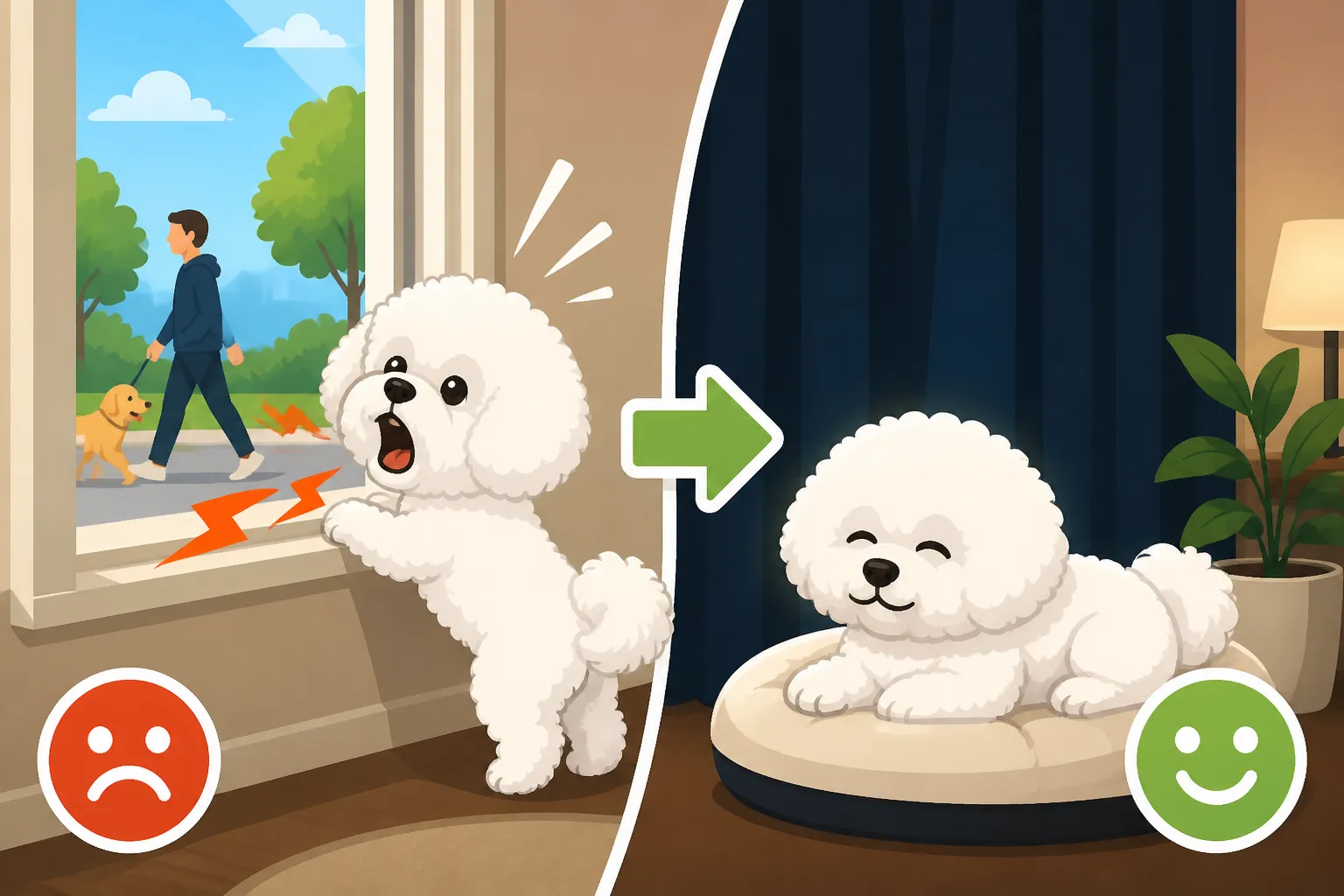
Whether Blocking the Window Quiets a Bichon Frise
Oh, the infamous window bark! If you're a Bichon Frise owner, you know this struggle all too well. It’s that piercing, often incessant barking that erupts every time a leaf blows, a distant dog barks, or a phantom presence graces your front lawn. It’s enough to make you consider soundproofing your entire house, or at least strategically placing cardboard over every pane of glass. This guide is for every owner who’s wondered if simply blocking the window will bring peace, and we'll explore not just that idea, but a whole host of realistic strategies to help manage this common, yet incredibly frustrating, Bichon behavior.
Understanding the "Why" Behind the Window Bark
Before we even think about solutions, it’s crucial to understand why your sweet, fluffy Bichon transforms into a tiny, vocal sentinel at the window. It’s rarely out of pure naughtiness, and more often a deeply ingrained instinct or learned behavior. Validating this helps us approach the problem with empathy, rather than just frustration.
The Territorial Bichon: Guarding Their Domain
Your Bichon Frise, despite its diminutive size, often sees itself as the fierce protector of your castle. They might not look like a Rottweiler, but in their mind, they're on guard duty. Every passerby, every delivery driver, every dog on a walk – these are perceived threats to their territory. The window provides a perfect vantage point to monitor their boundaries. When they see something they deem an intruder, their instinct kicks in, and they let out a barrage of barks to warn them off and alert you. It's their way of saying, "Hey, something's out there, and I'm on watch!"
This territorial drive is deeply rooted. Imagine being a small creature, yet believing it's your job to protect your pack. It can be exhausting for them, and certainly for you. This isn't just a casual "hello" bark; it's a serious alarm, and they truly believe they are doing their job. It's a common trait among many companion breeds who bond closely with their families and their home environment.
The Excitable Observer: Everything Is Interesting
Beyond territoriality, Bichons are often incredibly sensitive and alert to their surroundings. That little white puffball is also a keen observer, and the world outside the window is a constant source of fascinating stimuli. A squirrel scampering up a tree, a bird landing on a feeder, another dog walking by – these are all incredibly exciting events that can trigger an immediate, high-pitched vocal reaction. It's like watching a thrilling movie, and they just can't contain their commentary.
This type of barking often has an almost joyous, yet still piercing, quality to it. It’s less about guarding and more about pure, unadulterated excitement, or sometimes even frustration at not being able to interact with what they see. This can quickly escalate into what many call The Bichon Blitz and What It Means, where they race around, barking and zoomie-ing, fueled by the external stimulus. For a dog that thrives on interaction and can get easily overstimulated, a window acts as a direct feed to all the exciting happenings they can't quite reach.
The Bored Bichon: A Window to Entertainment
Let's be honest, sometimes our dogs get bored. If your Bichon isn't getting enough physical exercise, mental stimulation, or dedicated playtime, that window can become their primary source of entertainment. Staring out the window, even if nothing is happening, can be a way to pass the time. Then, when something does happen, it's a huge event! The barking is a way to alleviate boredom, burn off excess energy, and seek attention – either from the external world or from you.
Think about it from their perspective: if there's not much else going on, watching the world outside becomes the most engaging activity. A bored Bichon might start by just watching, but over time, any movement or sound becomes a cue to bark. It’s a self-reinforcing cycle: they bark, something (like a person walking away) might happen, and they associate their barking with that outcome. This can inadvertently teach them that their barking works to make things move, or at least brings some excitement into their day.
The Direct Impact of Blocking the Window: A Double-Edged Sword
So, you’ve hit your limit and decided to block the window. It feels like a logical first step, right? Eliminate the visual trigger, eliminate the bark. While it can offer some immediate relief, it’s important to understand that this isn’t always a magic bullet and can come with its own set of challenges.
The Immediate, and Sometimes Temporary, Relief
For many Bichon Frise owners, physically blocking the window can bring instant quiet, especially if the barking is primarily triggered by visual stimuli. If your dog barks mainly at squirrels or passersby, removing that sightline might reduce the barking dramatically. You might opt for opaque window film, blinds, or even strategically placed furniture. Amazon offers a variety of window films that can obscure the view while still letting in light, which can be a good starting point. This immediate reduction in noise can be a huge relief for a household desperately seeking peace.
However, this relief is often a management technique rather than a solution to the underlying behavior. It addresses the symptom, not the cause. If your Bichon is still experiencing the same levels of excitement, territorial drive, or boredom, those energies might find new outlets, or they might simply become more sensitive to sounds rather than sights. The quiet could be a temporary truce, not a permanent peace treaty.
The Shift in Focus: Sound, Shadows, and New "Windows"
When you block the visual aspect, your Bichon’s highly tuned senses don't just switch off. Instead, they might become hyper-aware of other triggers. Sounds, for example, become much more prominent. The distant bark of a dog, the rumble of a delivery truck, the footsteps on the pavement – these auditory cues, previously secondary to sight, now take center stage. Your Bichon might start barking at sounds alone, which can be even harder to manage because you can't "block" sound as easily as sight.
Another common shift is that your Bichon might find new "windows" to bark out of. Perhaps a glass door they previously ignored, or even a different window they hadn't paid much attention to. They might also start barking at shadows, reflections, or even internal household movements if they're particularly bored or anxious. The core drive to bark is still there; it's just redirected. In some cases, reducing environmental stimulation too much can even lead to other behavioral issues, like increased anxiety or destructive behaviors, as their pent-up energy and observational instincts have nowhere to go.
Pros and Cons of Window Blocking
Let’s lay out a quick summary of the good and bad when it comes to blocking those enticing windows for your Bichon Frise. It's a tool, not a complete strategy, and understanding its limitations is key.
| Aspect | Pros | Cons |
|---|---|---|
| Immediate Effect | Can significantly reduce visual-triggered barking instantly. | Often temporary, as underlying causes (boredom, territoriality) remain unaddressed. |
| Household Peace | Provides relief from incessant barking, reducing stress for owners. | Can shift barking to other triggers (sounds) or other windows/doors. |
| Simplicity | Relatively easy to implement with blinds, film, or furniture. | Doesn't teach the Bichon alternative, calmer behaviors. |
| Safety | Prevents Bichon from potentially jumping against windows or scratching. | Can lead to increased frustration or boredom for the dog if not supplemented with enrichment. |
| Aesthetics | Can be done subtly with decorative film or curtains. | May limit natural light or alter the look of your home. |
As you can see, while there are definite advantages to regaining some quiet, relying solely on blocking the view won't solve the core behavioral issues.
Beyond Blocking: Holistic Strategies for Window Barking
True, lasting change for window barking usually requires a multi-faceted approach. Think of it as a comprehensive training and lifestyle overhaul, tailored to your sensitive and intelligent Bichon Frise. Blocking the window can be one piece of the puzzle, but it’s rarely the whole picture.
Management Beyond Blocking: Reducing Exposure Strategically
Instead of completely blocking every window, consider strategic management. This could involve using baby gates to restrict access to certain rooms during peak "trigger" times (like when the mail carrier comes, or children are playing outside after school). You might only block the most problematic window, rather than every single one. For high-value windows, use opaque film on the bottom half, allowing light in but obscuring the ground-level view that often triggers their territorial instincts.
Another management tactic is to create a "safe space" or a designated resting area away from windows. This could be a comfy dog bed in a quiet corner of the living room, a crate in a den, or even a playpen where your Bichon can relax without constant external stimuli. Providing a quiet retreat can help reduce their overall arousal levels throughout the day. Remember, consistency is key; if the rule is "no window access," stick to it every time.
Training the "Quiet" Command and Redirection
This is where the real work begins, but it's also where you empower your Bichon with new skills. Teach a "Quiet" command. Start by intentionally exposing your Bichon to a mild trigger (maybe someone walking far down the street), let them bark a few times, then interrupt them with a treat held near their nose. The instant they're quiet to sniff the treat, praise them and give the treat. Over time, you can add the verbal cue "Quiet!" as they stop barking. The goal is to reward the silence, not the barking. Teaching a Bichon Frise a Quiet Cue is absolutely essential.
Simultaneously, practice redirection. When your Bichon starts to bark, instead of just saying "no," immediately call them away from the window with a happy tone and a high-value treat or a favorite toy. Engage them in a short play session or a quick training exercise in another part of the room. The idea is to teach them that seeing something outside doesn't mean barking; it means turning to you for something even better. This takes patience and repetition, but it's incredibly effective in the long run. Resources like BAXTER & Bella's online training programs can offer structured guidance on teaching these specific commands and redirection techniques, making the process much smoother for you.
Environmental Enrichment and Exercise: A Tired Bichon Is a Quiet Bichon
Often, window barking is a symptom of unmet needs for physical and mental stimulation. Bichons are intelligent little dogs and they need more than just a quick potty break in the yard. Increase their daily exercise with longer walks, play sessions, or even short training bursts throughout the day. A good walk around the neighborhood offers plenty of appropriate sniffing and exploration, which can be far more satisfying than staring out a window. Whether a Bichon Frise Settles After Exercise is a critical question, and often, the answer is yes!
Mental stimulation is just as important. Puzzle toys that dispense treats (many available on Amazon) can keep their minds engaged, working for their food instead of scanning for perceived threats. Teach them new tricks – Bichons are often quite agile and enjoy learning. Consider activities like canine freestyle or even introductory agility. Whether a Bichon Frise Can Do Agility might surprise you, but many small dogs excel at it! Engaging their minds with problem-solving tasks can significantly reduce boredom-induced barking. Rotate toys frequently to keep things fresh and interesting.
Ruling Out Medical Issues and Anxiety
Sometimes, what looks like naughty behavior can stem from underlying medical conditions or anxiety. Increased vocalization can be a sign of pain, discomfort, or age-related cognitive decline, especially in older Bichons. If your Bichon’s barking behavior has changed suddenly or seems excessive, a vet check-up is always a good idea to rule out any health issues.
Anxiety can also manifest as barking. If your Bichon is generally anxious, stressed, or suffers from separation anxiety, window barking might be an outlet for that heightened stress. Signs of anxiety can include pacing, panting, destructive behavior, or excessive licking. Your vet can help determine if anxiety is a factor and discuss options, which might include behavior modification, pheromone diffusers, or in some cases, medication to help reduce overall anxiety levels, making training more effective.
The Long Game: Consistency, Patience, and Positive Reinforcement
Let’s be real: changing deeply ingrained behaviors, especially something as instinctual as barking, doesn't happen overnight. It's a marathon, not a sprint, and your Bichon Frise needs your consistent effort and boundless patience.
Building a Consistent Routine
Dogs thrive on routine, and Bichons are no exception. A predictable schedule for walks, feeding, playtime, and training sessions can significantly reduce anxiety and provide a sense of security, which in turn can reduce window barking. If your Bichon knows when they’ll get their exercise and attention, they might be less inclined to seek stimulation (and bark) at the window. Establish clear rules about window access – perhaps certain windows are always blocked, or they only have supervised access to others.
Consistency also applies to how you react to the barking. Every family member needs to be on the same page with the "Quiet" command and redirection techniques. If one person allows barking and another tries to correct it, your Bichon will get mixed signals and progress will be slow. A household where everyone uses the same cues and rewards for desired behavior is crucial.
The Power of Positive Reinforcement
Bichons respond beautifully to positive reinforcement. Scolding, yelling, or punishing your Bichon for barking is almost always counterproductive. It can either make them more anxious, or they might learn to bark more because even negative attention is still attention. Instead, focus entirely on rewarding the behavior you want to see.
When your Bichon is calm near a window, or when they turn away from a trigger to look at you, immediately reward them with praise, a treat, or a favorite toy. Make it a celebration! This teaches them that being quiet and calm, or redirecting their attention to you, is incredibly rewarding. Over time, these positive associations will become stronger than the urge to bark. Remember, How Fast a Bichon Frise Learns a New Cue often depends on how clear and consistently rewarding your training methods are.
Celebrating Small Victories (and Managing Setbacks)
There will be good days and bad days. You might have a week where your Bichon is wonderfully quiet at the window, and then suddenly, a particularly brazen squirrel or a new delivery driver sets them off on a barking spree. Don't get discouraged! Celebrate the small victories – the times they didn't bark, the moments they looked at you instead of the window, the shorter duration of their barking fits.
Setbacks are part of the process. When they happen, don't revert to old habits. Go back to basics with your training. Reassess their environment: Have they had enough exercise today? Are they feeling bored? Is there a new stressor? Patience is the most important tool in your arsenal. With time, dedication, and a consistent positive approach, you absolutely can help your Bichon Frise become a calmer, quieter, and happier companion, even with a window in sight.
Disclaimer
This article is for general informational purposes only and does not constitute professional advice. Laws, prices and regulations vary by location and change over time. Consult a qualified professional for guidance on your specific situation.