Whether the Bichon Frise Standard Differs in Europe
A Bichon Frise shown in France may be assessed under different kennel-club rules than one shown in the United States, which can make the breed standard seem contradictory. The practical answer is that the broad picture is remarkably similar, but the wording, measurements, and show rules can differ. Here’s how to read those differences without mistaking a paperwork variation for a different kind of dog.
Europe does not have one universal Bichon Frise standard
FCI standards and national kennel clubs
“Europe” is not a single show system. Many European countries belong to the Fédération Cynologique Internationale, or FCI, which publishes an international breed standard for the Bichon Frise. National kennel clubs in member countries generally use that standard as their reference, while also managing local registrations, shows, and judging procedures.
The United Kingdom has its own Kennel Club system, and other European countries may have national rules or administrative practices that affect how a dog is registered and shown. Those systems can share the same broad breed description without being identical in every detail. So when someone says “the European standard,” it is worth asking which country and which organization they mean.
The FCI’s breed listing uses the name Bichon à poil frisé, which translates roughly as “Bichon with curly hair.” The breed identity is not fundamentally different from the Bichon Frise recognized in the United States. Both standards describe a small, white, curly-coated companion dog with a distinctive head and a lively expression.
For a broader look at the breed’s appearance, The Powder Puff Outline the Bichon Frise Standard Describes explains why the overall silhouette matters so much in the show ring.
How the FCI and American systems relate
In the United States, the American Kennel Club publishes its own breed standard. That standard guides AKC conformation shows and describes the ideal Bichon Frise for that system. The FCI standard plays a similar role across participating countries, but it is not simply an American standard translated word for word.
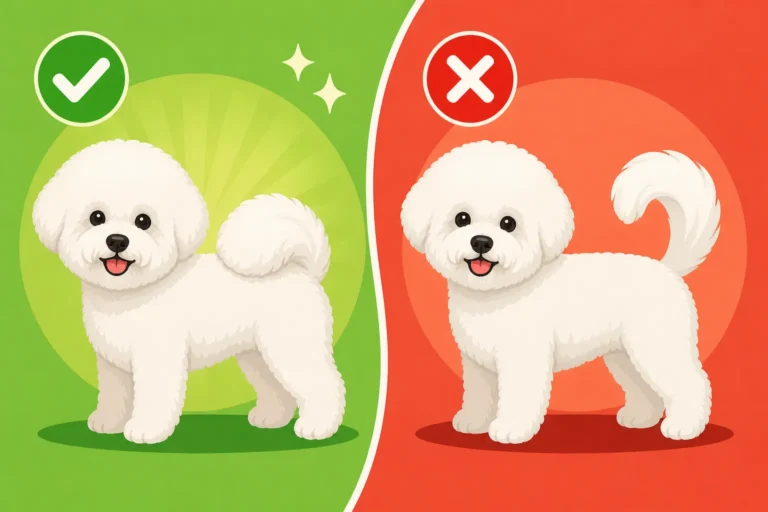
Both describe recognizable features such as a balanced, compact body, a curled tail carried over the back, a dark nose and eyes, and a white coat with a soft, powder-puff appearance. The standards also emphasize expression and proportion, rather than treating a single measurement as the only test of breed type.
The differences often become noticeable in the phrasing. One standard may spell out a feature in more detail, while another may leave room for judges to interpret the overall balance. That does not necessarily mean the ideal dog is substantially different. It means the details are organized and applied within separate kennel-club systems.
This distinction matters if you are comparing show results, reading a breeder’s description, or looking at dogs from different countries online. A photograph alone cannot tell you which standard was used, and a show title from one organization may not automatically mean the same thing in another.
Where the written standards can differ
Height and measurement language
Height is one of the easiest differences to spot because standards may use different units and present the acceptable range in different ways. The AKC standard gives a height range in inches, while the FCI standard expresses height in centimeters. Converting between units can make the ranges look slightly different even when they describe dogs of broadly similar size.
The standards may also differ in how they express allowances, preferred proportions, or the consequences of falling outside the stated range. A dog that seems to meet a number on a converted chart is not automatically considered ideal under every organization’s rules. Judges assess the dog according to the standard and show regulations that apply in that venue.
For pet owners, the key takeaway is not to treat a small difference in listed height as evidence that European Bichons are a separate size variety. A Bichon can vary naturally in build, and a dog’s height needs to be measured consistently at the withers. Informal estimates based on a standing photo are especially unreliable.
Weight is another area where owners may see different figures in websites or breed descriptions. Some sources give a typical weight range, while standards may focus more on proportion and condition than on a strict weight target. A healthy body condition and sound movement matter more than matching a number copied from a general breed page.
Coat color and puppy shading
Both major standards describe a white Bichon Frise, but they may phrase the allowance for light shading differently. The AKC standard permits limited buff, cream, or apricot coloring in certain areas, while FCI wording describes a white coat and recognizes limited ivory or champagne shading in young dogs. The precise phrasing and how it is applied should be checked in the specific organization’s current standard.
That distinction is particularly relevant when looking at puppies. A young Bichon may have faint cream or champagne shading that becomes less noticeable as the coat matures. A pale patch on a puppy is not, by itself, proof that the dog is not a Bichon Frise. But the amount, location, and age of the dog can matter in the show context.
For families choosing a pet, coat shading is usually less consequential than health, temperament, and responsible breeding. Show eligibility is a separate question from whether a dog can be a well-loved companion. If a breeder makes a strong claim about a puppy’s color or show prospects, ask which kennel-club standard they are referring to and request the relevant written wording.
| Feature | American Kennel Club approach | FCI approach | What an owner should take from it |
|---|---|---|---|
| Height | Stated in inches | Stated in centimeters | Unit conversion and wording can make ranges look different |
| Coat | White, with limited shading allowed in specified circumstances | White, with limited young-dog shading described in the standard | Puppy shading and adult coat color are not always identical |
| Overall type | Emphasizes the breed’s balance, expression, coat, and outline | Also emphasizes a compact, balanced dog with characteristic coat and expression | The ideal remains recognizably the same breed |
| Show rules | Applied in AKC events | Applied through FCI-related and national systems | Titles and judging procedures belong to their respective systems |
What remains consistent across the standards
The Bichon’s recognizable outline and expression
Even where the wording varies, the standards point toward a familiar breed picture: a small, sturdy dog with a rounded, well-balanced appearance, a curly white coat, dark eyes, and a lively expression. The Bichon should not look fragile simply because it is small, nor should its coat overwhelm the dog’s underlying structure.
The head shape and presentation can make the breed look quite different from one groom to another. A full, rounded head is associated with the classic show outline, while a shorter pet trim may reveal more of the dog’s natural proportions. Neither haircut changes the dog’s registered breed, though grooming can affect how closely the dog resembles the standard in a show setting.
If you are trying to understand what that outline means in practice, The Powder Puff Outline a Bichon Frise Is Scissored Into describes the grooming shape associated with the breed. For the role of coat and trimming in the show ring, Why a Groomer Scissors a Bichon Frise Instead of Clipping It offers useful context.
Coat care is not a different breed rule
A European standard does not mean a Bichon suddenly needs a different kind of daily care. The coat still needs regular brushing and combing to prevent tangles and mats, especially behind the ears, under the legs, and around areas where a harness rubs. A dog kept in a shorter pet trim may be easier to maintain, but short coats still need routine brushing and grooming appointments.
When choosing tools, think about the coat condition and your dog’s comfort rather than assuming there is a special “European” brush. A gentle slicker brush and a metal comb are common grooming tools, but technique matters: work in small sections and check down to the skin instead of brushing only the visible surface. Retailers such as Chewy carry grooming supplies, but compare the tool’s description and suitability for your dog’s coat rather than choosing by a label that promises a particular national style.
A standard describes the ideal appearance for judging; it is not a daily grooming checklist that every pet owner must reproduce. If your Bichon is uncomfortable with long grooming sessions, a practical trim and calm, gradual handling may suit your household better than trying to maintain a show coat. Whether a Pet Trim Suits a Bichon Frise explores that choice from an everyday-care perspective.
How to use the standards when choosing or showing a Bichon
Ask which organization a breeder means
If a breeder says a puppy is “to standard,” ask which standard they mean. A breeder working with AKC shows may be referring to the AKC standard, while a breeder in an FCI country may be discussing the FCI standard or a national club’s application of it. The phrase alone does not identify the registration system or guarantee that a puppy will be a show prospect.
It is also reasonable to ask what health screening is performed and whether the breeder can explain the puppy’s parents, temperament, and care needs. A show-quality description is not a substitute for health information. A useful starting point is The Health Tests Both Bichon Frise Parents Should Have, which discusses questions to raise when considering a litter.
If you are comparing a European listing with an American one, look for the kennel club named on the registration documents. Then compare the actual standard from that organization, rather than relying on a breeder’s shorthand or a general breed page. This helps avoid confusion over measurements, color wording, and what a title represents.
Understand what show titles do and do not prove
A championship or show qualification indicates that a dog has been evaluated within a particular competition system. It does not mean every country uses identical rules, nor does it mean the dog is guaranteed to produce puppies with the same features. Titles provide useful context, but they are only one part of assessing a breeder and a dog.
If you plan to show a Bichon, contact the national kennel club or the show organization where you intend to compete. Confirm registration eligibility, the applicable standard, and any event-specific rules. Grooming and presentation expectations may also vary, so a handler familiar with that show system can help explain what judges expect without treating one style as universal.
For a pet owner, none of this needs to become a source of worry. A Bichon does not have to match every show detail to be a wonderful companion. Health, comfort, temperament, and a coat-care routine your household can sustain are more important in everyday life than whether the dog’s outline matches a ring presentation.
When you want to compare grooming tools or basic supplies, Chewy can be one place to review product descriptions, but the standard itself is best checked with the relevant kennel club. If you are planning a show coat, ask an experienced Bichon groomer or handler to explain what is expected in your specific competition system. For ordinary home care, prioritize a comfortable brush-out routine and a groom that works for your dog.
Disclaimer
This article is for general informational purposes only and does not constitute professional advice. Laws, prices and regulations vary by location and change over time. Consult a qualified professional for guidance on your specific situation.