Whether a Bark Collar Belongs on a Bichon Frise
One of the most common complaints I hear from fellow Bichon Frise parents, and something I've certainly experienced myself, is the challenge of managing excessive barking. It can be incredibly frustrating when your sweet, fluffy companion turns into a tiny alarm system, disturbing neighbors, interrupting your peace, and sometimes even straining the bond you share. This comprehensive guide will delve into whether bark collars are a suitable solution for a Bichon Frise and, more importantly, explore humane, effective strategies to help your little one achieve a quieter, happier existence without resorting to harsh methods.
Understanding Why Your Bichon Frise Barks Excessively
Before we even consider solutions, it's crucial to understand why your Bichon Frise might be barking more than you’d like. It’s rarely just "being naughty"; there's almost always an underlying reason, and identifying it is the first step towards a lasting solution. Barking is a form of communication, after all, and our job as responsible pet parents is to figure out the message.
Natural Tendencies and Breed Characteristics
Bichon Frises, with their charming, alert, and intelligent dispositions, are often quite vocal. They were originally bred to be companion dogs, always at their human's side, and part of that role sometimes involved alerting their family to anything unusual. This means they can be prone to "alert barking" – letting you know a leaf just blew past the window, or the mail carrier is two blocks away. It’s in their DNA to be observant and to communicate their observations! This inherent tendency doesn't mean it can't be managed, but it does mean we need to approach it with understanding. You might even find your Bichon Frise has a surprisingly loud bark for such a small dog! Whether a Bichon Frise Is a Yappy Breed is a question many owners ponder, and while they can be, it's not a universal truth.
It's important to differentiate between typical breed vocalizations and genuine excessive barking. A few barks to greet you, or a short "woof" at a squirrel, is perfectly normal. However, sustained barking that seems disproportionate to the trigger, or barking that occurs frequently without an obvious cause, points to a deeper issue. Their bright, cheerful nature, sometimes expressed through what we affectionately call "the Bichon Blitz," can also translate into bursts of vocal energy.
Environmental Triggers and Learned Behaviors
Often, excessive barking isn't just innate; it's a response to their environment or something they've learned. Think about what sets your Bichon off. Is it every time someone walks past the window? That's classic "window barking." Is it when you leave the house? That could indicate separation anxiety. Or perhaps they bark at every new sound in the hallway of your apartment building. These are all external triggers that your Bichon learns to react to, and if the barking gets them what they want (attention, the perceived "threat" leaving, or even just you scolding them, which is still a form of attention), they'll keep doing it.
Consider the classic scenario: your Bichon barks at the mail delivery person. The mail person leaves. In your dog's mind, their barking made the person leave, thus reinforcing the behavior. This type of self-reinforcing cycle can be incredibly difficult to break without intervention. Moreover, some dogs learn that barking gets them attention, food, or playtime, even negative attention. A quick yell of "Quiet!" might temporarily stop the barking, but it also tells your dog that barking does get your attention, which can strengthen the habit in the long run.
Underlying Health Issues and Anxiety
Sometimes, barking isn't behavioral at all; it's medical. Pain, discomfort, or an underlying health condition can cause a dog to vocalize more. For instance, a urinary tract infection might lead to more frequent urination and vocalizing due to discomfort. Or perhaps joint pain from conditions like Slipping Kneecaps in a Bichon Frise could make them grumpy and more reactive. It's always wise to rule out any medical causes with your veterinarian, especially if the barking is a new or suddenly increased behavior.
Anxiety is another major culprit. Bichons are highly attached to their families, and separation anxiety can manifest as incessant barking, howling, and destructive behaviors when left alone. Fear-based barking, where a dog barks out of insecurity or fear of strangers or new situations, is also common. A dog might bark excessively because they're under-exercised, under-stimulated, or simply bored. Boredom barking is often a cry for attention or something to do. Always consider your Bichon's overall well-being and emotional state when evaluating their barking habits.
The Different Types of Bark Collars and How They Work
When searching for solutions to barking, you’ll inevitably come across bark collars. There are several types, and they all operate on the principle of delivering an aversive stimulus to interrupt the barking. However, the type of stimulus and its potential impact vary greatly. It’s crucial to understand these differences before considering any of them for your sensitive Bichon.
Static Correction Collars: What They Are and Considerations
Static correction collars, often simply called "shock collars," deliver a mild electrical stimulation when the dog barks. The intensity is usually adjustable, and modern versions are designed to be uncomfortable rather than painful. They often have different settings, starting from a low warning tone or vibration before escalating to a static correction if the barking continues. Some even have progressive modes where the correction increases with sustained barking.
The idea behind these collars is straightforward classical conditioning: dog barks, dog receives an unpleasant sensation, dog learns to associate barking with the sensation and stops. For a small, sensitive breed like a Bichon Frise, the application of such a collar raises significant concerns. Bichons are often very attuned to their owner's emotions and environment. A static correction, even if mild, can be a profoundly confusing and frightening experience for them, potentially leading to fear, anxiety, and a breakdown in trust. Imagine receiving an unpredictable zap for something that, to you, feels like a natural communication. It doesn't teach why not to bark, only that barking has a negative consequence.
Vibration and Ultrasonic Collars: A Gentler Approach
Vibration collars, as their name suggests, deliver a vibrating sensation to the dog's neck when they bark. These are generally considered much more humane than static correction collars, as they don't involve electrical impulses. The vibration is meant to be startling or distracting enough to interrupt the barking pattern. Some dogs respond well to this gentle nudge, finding it enough to break their focus on whatever they were barking at.
Ultrasonic bark collars emit a high-frequency sound that is typically inaudible to humans but unpleasant for dogs. The sound is triggered by barking and is intended to deter the dog from continuing. Both vibration and ultrasonic collars are often marketed as "humane" alternatives to static collars. While they avoid physical pain, they still function on the principle of aversion. For a Bichon, a constant high-pitched sound or repeated vibrations can still be a source of stress or confusion. There's also the risk of desensitization; some dogs quickly learn to ignore the mild discomfort or sound, especially if their motivation to bark (e.g., severe separation anxiety or fear) is very strong. Moreover, the sound from ultrasonic devices can be indiscriminate, potentially affecting other dogs in the vicinity or even your own dog when they're not barking.
Citronella Spray Collars: Scent-Based Deterrents
Citronella spray collars release a burst of citronella scent (or sometimes unscented air) when the dog barks. The spray is startling, and the scent itself is usually disliked by dogs. The idea is that the dog associates barking with the unpleasant spray and learns to stop. Many owners prefer these collars because they don't involve electricity or harsh sounds.
While often perceived as the "kindest" of the bark collar options, citronella collars still operate on aversion. The sudden spray can be startling, and the scent can linger, potentially causing ongoing discomfort. For a Bichon, who might be quite sensitive to smells, this can be more impactful than for a larger, less scent-sensitive breed. There's also the practical consideration of refilling the spray canister. Like other aversive collars, they don't teach the dog what to do instead of barking, nor do they address the root cause of the barking. If the underlying issue is anxiety or fear, simply stopping the barking with an unpleasant spray might suppress the symptom but exacerbate the underlying emotional problem.
The Case Against Bark Collars for Bichon Frises
While bark collars might seem like a quick fix, especially when you're at your wit's end, it’s crucial to understand why they are generally not recommended for sensitive breeds like the Bichon Frise. My philosophy, and that of many modern dog trainers, centers on building trust and understanding, not on suppressing behavior through fear or discomfort.
Potential for Fear, Anxiety, and Stress
Bichons are known for their sweet, affectionate, and often quite sensitive natures. Introducing an aversive device like a bark collar, especially a static one, can be profoundly detrimental to their emotional well-being. Imagine your dog barks because they're genuinely afraid of a new sound outside. If a collar then zaps them for that fear-induced bark, they learn that expressing their fear leads to punishment. This can escalate their anxiety, potentially leading to a more fearful or even aggressive dog, or causing them to shut down entirely.
The unpredictable nature of some collars can also be very stressful. If the collar malfunctions, or if another sound triggers it incorrectly, your Bichon might receive a correction when they haven't actually barked. This creates immense confusion and can erode the dog's trust in their environment and even in you, their primary caregiver. Instead of learning to be quiet, they may learn to be anxious, constantly anticipating an unpleasant sensation. A stressed dog is not a happy dog, and the goal of living with a Bichon is usually joy and companionship.
Lack of Addressing the Root Cause
This is perhaps the biggest flaw of bark collars: they are purely suppressive. They aim to stop the symptom (barking) without ever investigating or resolving the underlying problem. If your Bichon is barking due to separation anxiety, a bark collar might stop the noise, but it won't alleviate the intense distress your dog feels when left alone. In fact, by preventing them from vocalizing their anxiety, you might be creating a pressure cooker effect, where the anxiety builds and eventually manifests in other, potentially worse ways, such as destructive chewing, house soiling, or self-mutilation.
For example, if your Bichon barks at visitors because they are undersocialized and fearful, a bark collar will only punish their attempt to communicate discomfort. It won't teach them that visitors are safe or how to react calmly. Addressing the root cause means understanding why the barking is happening and then implementing strategies to change the dog's emotional response or environment. A collar simply acts as a mute button, and that's not fair to an animal that relies on vocalization to express its needs and feelings.
Ethical Concerns and Long-Term Behavioral Impact
Many modern dog training methodologies advocate for force-free, positive reinforcement techniques, and bark collars simply don't fit into that philosophy. The ethical concerns center on the idea of intentionally causing discomfort or fear to an animal, especially one as devoted and dependent as a Bichon. We want our dogs to learn because they are motivated and enjoy the process, not because they are trying to avoid an unpleasant sensation.
The long-term behavioral impact can be subtle but damaging. A dog that learns to suppress natural behaviors might become withdrawn, less confident, or even develop new, undesirable behaviors as a coping mechanism. It can damage the bond between you and your dog if they associate your presence (or the collar you put on them) with discomfort. Instead of a happy, expressive companion, you might end up with a dog that is quiet but secretly stressed, or one that is confused and anxious. Before you consider anything that causes discomfort, remember that there are many alternative tools and strategies to help your dog, and they are almost always more effective in the long run.
Effective, Humane Alternatives for Managing Bichon Frise Barking
The good news is that there are numerous effective, humane, and positive ways to manage and reduce excessive barking in your Bichon Frise. These methods focus on understanding, training, and environmental adjustments, building a stronger, more trusting relationship between you and your furry friend.
Consistent Positive Reinforcement Training
This is the cornerstone of effective barking management. Instead of punishing barking, you teach your Bichon what to do instead.
- Teach a "Quiet" Cue: This is essential. Start by letting your Bichon bark a few times at a mild trigger (like a knock on the door or a person walking by). As soon as they quiet down for a second, mark the silence with a "Yes!" or a clicker, and immediately reward them with a high-value treat. Repeat, gradually increasing the duration of silence before the reward. Once they understand the concept, you can add a verbal cue like "Quiet" just before they settle. The goal is to reward the absence of barking, not the barking itself. Teaching a Bichon Frise a Quiet Cue is entirely possible with patience.
- "Thank You and Go To Your Mat": For doorbell barking, you can teach them to bark a couple of times (their alarm job) and then go to a designated mat or bed for a treat. This allows them to fulfill their alerting instinct but then directs them to a calm, quiet behavior.
- Desensitization and Counter-Conditioning: If your Bichon barks at specific triggers (e.g., people walking past the window, or noises from outside), you can gradually expose them to these triggers at a low intensity while simultaneously feeding them high-value treats. For instance, start with the blinds slightly open and toss a treat every time someone walks by before your dog reacts. The goal is to change their emotional association from "threat" to "treat." Over time, they learn that the trigger predicts good things, not something to bark at. Whether Blocking the Window Quiets a Bichon Frise can be a temporary management strategy, but desensitization aims for a deeper behavioral change.
- Enroll in Training Classes: Group classes or private sessions with a certified professional dog trainer (CPDT) can provide invaluable guidance. They can assess your Bichon's specific barking triggers and help you develop a tailored training plan using positive reinforcement. Look for trainers who emphasize reward-based methods and ethical practices. Platforms like BAXTER & Bella offer online resources and courses that can guide you through positive training methods, focusing on building a well-behaved companion without force.
Environmental Management and Enrichment
Sometimes, simply changing your Bichon's environment or providing more mental and physical stimulation can significantly reduce barking.
- Remove or Block Triggers: If window barking is a major issue, simply blocking access to the window with frosted film, curtains, or even a strategically placed piece of furniture can prevent the visual trigger. Sometimes, preventing the trigger entirely is the quickest short-term solution while you work on training.
- Increase Exercise: A tired Bichon is often a quieter Bichon. Ensure your dog gets adequate physical exercise tailored to their age and health. This doesn't mean marathon runs, but consistent walks, playtime in a secure yard, or indoor games can burn off excess energy that might otherwise fuel barking.
- Mental Stimulation: Bichons are intelligent and thrive on mental engagement. Puzzle toys, snuffle mats (which you can often find readily on Amazon), and training sessions where they learn new tricks can provide mental enrichment. Even just five to ten minutes of training per day can make a big difference. Think about What a Bichon Frise Needs Every Day – and mental exercise is definitely on that list!
- Create a Safe Haven: If your Bichon barks out of anxiety, especially separation anxiety, creating a cozy, safe space (like a crate or a comfortable bed in a quiet room) can help. Provide comforting items like a scent-soaked shirt of yours or a safe chew toy. Consider background noise like a radio or white noise machine to mask external triggers.
- Manage Alone Time: If your Bichon barks when left alone, gradually increase the duration of your absence. Start with very short periods, rewarding quiet behavior upon your return, and slowly build up. This goes hand-in-hand with desensitization for separation anxiety. If you notice your Bichon cries when you leave, Whether a Bichon Frise Cries When You Leave is a strong indicator of separation anxiety, which collars will only mask.
Seeking Professional Guidance
There are times when despite your best efforts, the barking persists or seems to worsen. This is not a failure on your part, but an indication that it's time to bring in the experts.
- Certified Professional Dog Trainer (CPDT): As mentioned, a CPDT can offer personalized strategies. They can observe your Bichon in their environment, identify specific triggers and motivations for barking, and guide you through positive reinforcement techniques. Many trainers offer virtual consultations, making it easier to get help from the comfort of your home.
- Veterinary Behaviorist (Dip ACVB): For severe cases, particularly those involving anxiety, aggression, or complex behavioral issues, a veterinary behaviorist is the most qualified professional. These are veterinarians who have specialized in animal behavior, and they can diagnose behavioral conditions, prescribe medication if necessary (e.g., anti-anxiety medication for severe separation anxiety), and work in conjunction with a trainer to implement a comprehensive behavior modification plan.
- Online Resources and Courses: Reputable online platforms, like BAXTER & Bella's Online Puppy School, can provide structured training programs that cover common behavioral issues, including barking, using humane and effective methods. These programs often include video tutorials, live Q&A sessions, and personalized support, which can be a fantastic resource for Bichon owners looking for guidance on managing their dog's behavior proactively.
| Bark Collar Type | Primary Mechanism | Pros | Cons | Impact on Bichon Frise | Recommended for Bichon Frise? |
|---|---|---|---|---|---|
| Static Correction (Shock) | Electrical impulse | Can be effective at stopping barking quickly | High potential for fear, anxiety, pain; doesn't address root cause; ethical concerns | Likely to cause distress, fear, erosion of trust, increased anxiety | No |
| Vibration | Physical vibration | No pain involved, startling | Can be ignored (desensitization); doesn't address root cause; can still cause stress or confusion | Potentially stressful, confusing; may suppress behavior temporarily | Generally No |
| Ultrasonic | High-frequency sound | No physical contact | Can be ignored; inconsistent effectiveness; can cause stress/anxiety; indiscriminate sound; doesn't address root cause | Potentially irritating, stressful; may not be effective | No |
| Citronella Spray | Startling spray + scent | No electricity, no pain | Can be startling and unpleasant; scent can linger; doesn't address root cause; can cause anxiety | Likely to cause aversion, confusion; may exacerbate underlying anxiety | Generally No |
| Positive Reinforcement Training | Rewards for desired behavior | Builds trust, addresses root cause, humane, long-lasting results, strengthens bond | Requires patience, consistency, understanding of dog behavior | Promotes confidence, calm, happiness, and understanding | Yes (Always!) |
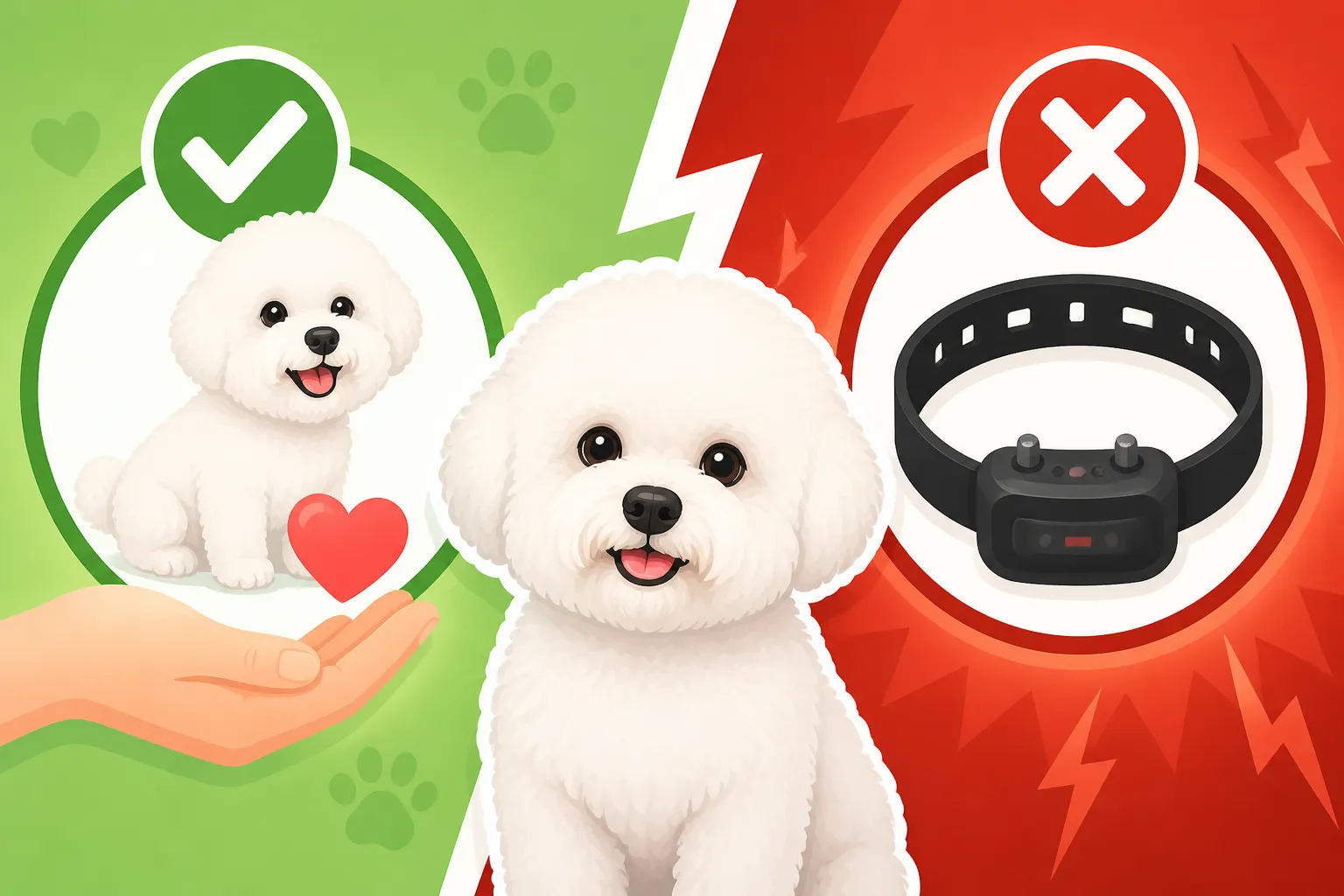
Ultimately, while the immediate quiet a bark collar might offer can be tempting, the long-term emotional and behavioral health of your Bichon Frise is far more important. Investing time and effort into positive, humane training methods will not only solve the barking issue more effectively but will also foster a deeper, more loving, and trusting relationship with your cherished companion.
Disclaimer
This article is for general informational purposes only and does not constitute professional advice. Laws, prices and regulations vary by location and change over time. Consult a qualified professional for guidance on your specific situation.