Whether a Bichon Frise Jumps Up on People
It’s a tale as old as time, or at least as old as having an adorable, fluffy Bichon Frise: you walk in the door, or a friend visits, and before you can even set down your keys, your sweet little cloud of joy launches itself upwards, paws flailing, eager to greet. While it might seem cute when they’re a tiny puppy, a full-grown Bichon jumping up can be annoying, startling, or even knock someone off balance. If you’ve been frustrated by your Bichon’s jumping habits, this guide is here to help you understand why they do it and, more importantly, how to teach them better manners for more enjoyable greetings.
Why Your Bichon Frise Jumps Up in the First Place
Understanding the root cause of any behavior is the first step towards changing it, and jumping up is no exception. It’s rarely about defiance or being "naughty"; instead, it's usually deeply ingrained in their canine nature and reinforced, often unintentionally, by us humans.
Seeking Attention and Greeting Rituals
Dogs are social creatures, and for many, jumping up is a natural part of their greeting ritual. In the wild, or even in a multi-dog household, dogs might jump and paw at each other's faces as a form of social interaction. They're trying to get closer to your face, which is their equivalent of saying "hello!" and reading your emotional state. For a small dog like a Bichon Frise, jumping is often their best shot at reaching that coveted face level. They want to be noticed, to be acknowledged, and to feel connected to you the moment you arrive or a new person enters their space. It's their way of initiating contact and demanding attention, and let's be honest, who can resist that fluffy little face?
This desire for connection is particularly strong in a breed like the Bichon, known for its affectionate and outgoing nature. They thrive on companionship and being the center of attention. When you walk in the door after a long day, your Bichon isn't thinking, "I should keep all four paws on the floor." They're thinking, "My favorite person is home! I must tell them how much I missed them!" Every glance, every coo, every gentle push down, even if meant to discourage, can inadvertently serve as a form of attention, reinforcing the very behavior you're trying to stop. They learn quickly that jumping gets a reaction, and any reaction is often better than none.
Excitement and Over-Stimulation
Think about the context in which your Bichon jumps. Is it usually when you first get home? When new guests arrive? When the leash comes out for a walk? These are all moments of high excitement and stimulation for your dog. Bichons, with their lively and joyful personalities, can get incredibly wound up in these situations. Their little bodies are practically vibrating with anticipation and happiness.
When a Bichon is overwhelmed with excitement, their impulse control can go right out the window. They're not consciously choosing to jump; they're simply reacting to a surge of emotion. It's like a child bouncing off the walls on Christmas morning. Their minds are racing, their hearts are pounding, and all that energy has to go somewhere. Unfortunately, for many Bichons, that "somewhere" is a vertical leap. This is especially true for young puppies who haven't yet learned self-control or for dogs who don't get enough consistent mental and physical exercise to help them manage their energy levels. Ensuring your Bichon gets proper exercise and mental enrichment can go a long way in tempering this kind of over-the-top excitement. You might find some helpful tips in Whether a Bichon Frise Settles After Exercise.
Learned Behavior and Accidental Reinforcement
Perhaps the most significant reason your Bichon jumps up is that, at some point, it's been rewarded. This doesn't mean you deliberately encouraged it; far from it! But dogs are masters of association. If, when your Bichon was a puppy, it jumped up and you gently picked it up, or even just spoke to it, it learned that jumping leads to positive attention. When friends come over and say, "Oh, how cute!" while your Bichon jumps at their knees, that's a reward. If you push your dog down but then immediately pet them as they briefly touch the floor, they might associate the pet with the preceding jump.
Think about the cycle: Bichon jumps, you react (even negatively), Bichon gets attention, Bichon learns to jump again. This cycle is incredibly powerful. Even looking at your dog, making eye contact, or saying "no" can be enough to reinforce the behavior because it provides the attention they're seeking. Breaking this cycle requires a conscious effort to remove all forms of reinforcement for the jumping behavior. Consistency across everyone who interacts with your dog is absolutely vital for this to work. A single person reinforcing the behavior can undo weeks of training.
Understanding the Impact of Jumping Up
While your Bichon Frise's jumping might stem from a place of pure, unadulterated love and excitement, it's important to recognize that this behavior isn't always harmless. What starts as a cute quirk in a tiny puppy can quickly become a genuine problem as they grow and mature.
The Good, the Bad, and the Annoying
Let's be honest, when your Bichon is a small ball of fluff, those little jumps can be endearing. A tiny puppy pawing at your leg might elicit an "aww" and a quick cuddle. This initial, positive reaction is often where the problem begins. We accidentally teach them that jumping is a good way to get our attention. As they get older, however, and gain a bit more size and enthusiasm, those same jumps lose their charm.
Suddenly, those "cute" puppy jumps turn into an annoying habit. Your Bichon, still thinking they're doing something delightful, might jump on your freshly laundered clothes, leaving paw prints. They might scratch bare legs, or tangle themselves in your shopping bags. The playful leaps can become jarring and disruptive, especially when you're trying to carry something or engage in a conversation. It shifts from an innocent greeting to an irritating demand for attention, leaving you and your visitors feeling more frustrated than flattered. This transition from endearing to exasperating is a common lament among owners who initially tolerated the behavior.
Safety Concerns and Social Etiquette
Beyond mere annoyance, a jumping Bichon Frise can pose legitimate safety concerns, particularly for certain individuals. Imagine an elderly relative with fragile bones, or a small child who could easily be knocked off balance by even a relatively small dog. A Bichon's enthusiastic leap, even if unintentional, could cause a fall, leading to injury. For children, especially, it can also teach them that dogs are unpredictable or even scary, which is the last thing you want for building positive human-animal relationships.
Furthermore, consider the social implications. Not everyone loves dogs, and even dog lovers might not appreciate a furry greeting that involves muddy paws on their clothes or a dog's nose in their personal space. When you have guests over, a jumping dog can make them feel uncomfortable and unwelcome, rather than happy to visit. It becomes a matter of proper social etiquette, ensuring your dog can coexist politely with others. For owners who wish their Bichon could be a therapy dog, for example, addressing jumping is absolutely essential. A dog that can maintain Whether a Bichon Frise Earns a Canine Good Citizen Title is a joy to take out, while a jumper can limit where you can go and who you can see. Investing time in polite greeting behaviors not only makes your home a more pleasant place but also allows your Bichon to be a more welcome and well-adjusted member of society.
Practical Strategies to Stop Your Bichon From Jumping
Now that we understand why your Bichon might be jumping and the impact it has, let's dive into actionable strategies. The key here is consistency, clear communication, and a united front from everyone who interacts with your dog.
The "No Paws On the Floor" Rule
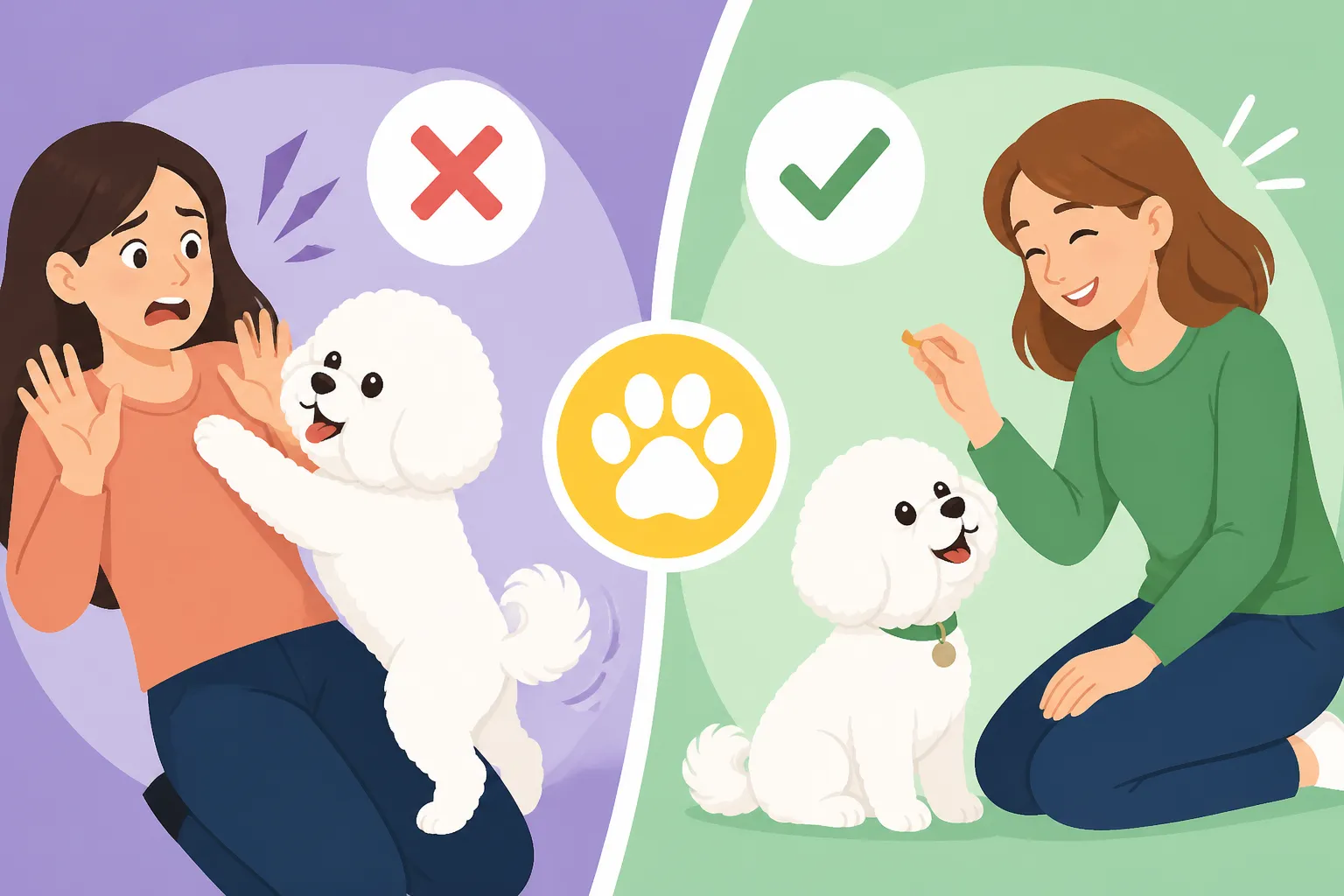
This is perhaps the most fundamental principle for stopping jumping behavior. The rule is simple: if four paws are not on the floor, your Bichon gets absolutely no attention. This means no eye contact, no talking, no touching, no pushing them away, no "no!" – nothing. The moment your Bichon jumps, turn your back, cross your arms, and become a stone statue.
It can feel counterintuitive, especially when your dog is actively vying for your attention, but it’s incredibly effective. As soon as all four paws are back on the floor, then and only then, can you offer calm, gentle praise or a low-value treat. If they jump again, repeat the process. This teaches them that jumping makes you disappear (emotionally, at least) and staying grounded brings good things. This strategy requires immense patience, especially at first, but your Bichon will eventually make the connection. Imagine coming home from work; instead of rushing to greet your jumping dog, you calmly walk past them, drop your bags, and only when they sit or stand calmly will you offer a pet. This might feel harsh, but it's the clearest message you can send.
Teaching an Alternative Behavior
Instead of just telling your Bichon what not to do, it's far more effective to teach them what to do instead. The most common and useful alternative behavior for greetings is a "sit" or a "four-on-the-floor" command.
Start by practicing "sit" in a low-distraction environment. When your Bichon reliably sits on cue, begin integrating it into greeting scenarios. As you approach the door or as a guest prepares to enter, ask your Bichon to "sit." If they hold the sit, even for a second, reward them enthusiastically with praise and a treat. If they break the sit and jump, immediately disengage (turn your back, no attention) until they settle again, then try again. For some dogs, a "down" stay might be an even better alternative, as it prevents any upward motion. The goal is to make sitting (or lying down) the default greeting behavior that earns them all the wonderful attention they crave. You can find some excellent structured lessons on teaching basic commands from online platforms like BAXTER & Bella's online puppy school, which guides you through these steps systematically. Resources like What a Bichon Frise Will Work For might give you ideas for high-value rewards to keep them motivated.
Managing the Environment and Greetings
Prevention is a powerful tool in training. By managing the environment, you can set your Bichon up for success and reduce opportunities for unwanted jumping.
- Leash Control: When guests arrive, or you come home, keep your Bichon on a leash. This gives you immediate control. As they start to jump, gently guide them back down with the leash, while simultaneously cueing a "sit." Release the leash only when they are calm and exhibiting the desired behavior. A comfortable harness is ideal for this, as it reduces pressure on their delicate neck. You might find more information on suitable equipment in Whether a Bichon Frise Should Wear a Harness.
- Crating or Confinement: For highly excitable Bichons, or during times when you cannot actively supervise (e.g., a busy party), using a crate or a playpen can be invaluable. This allows them to be part of the activity from a safe distance without practicing unwanted behaviors. Once they have calmed down, you can then release them to greet guests one-on-one, on-leash, and only after they sit politely. Having a comfortable, designated safe space like a crate can be very beneficial, and you can learn more about costs in What a Crate and Playpen Cost a Bichon Frise Owner.
- Controlled Greetings: Ask visitors to ignore your Bichon completely until they are calm. This means no looking, no talking, no touching. Once your Bichon offers a calm sit, then the visitor can offer a gentle, calm pet. If the Bichon jumps, the visitor immediately stands up, turns their back, and waits for four paws on the floor again. This is where communication with your friends and family is key; everyone needs to be on the same page.
Remember, the goal is to prevent your Bichon from practicing the unwanted behavior as much as possible, while simultaneously reinforcing the desired calm behavior.
Consistency and Patience
This isn't a quick fix, especially if your Bichon has been practicing jumping for a while. It takes time, patience, and absolute consistency from every single person who interacts with your dog. One person giving in to the jumping, even "just this once," can set back your training significantly.
Establish clear rules for greetings, and make sure everyone in the household, and even frequent visitors, understands and adheres to them. It's often helpful to have a visual cue, like a sign on the door reminding guests of your dog's training rules. The more consistent you are, the faster your Bichon will learn. Expect setbacks; training isn't linear. There will be days when you feel like you've made no progress, but don't give up. Celebrate small victories, like a calm two-second greeting, and build on those. For new owners, this can be particularly challenging, but patience pays off in the long run. If you're a first-time owner, you might appreciate resources on Whether a Bichon Frise Suits a First Time Owner.
Tools and Training Aids That Can Help
While the core of addressing jumping involves consistent training and clear communication, certain tools and resources can certainly make the journey a bit smoother.
Harnesses and Leashes for Control
A well-fitting harness and leash are your best friends when it comes to managing a jumping Bichon, especially during greetings or when you're out and about. Unlike a collar that can put pressure on their throat, a harness distributes pressure more evenly and gives you better control over your dog's body without causing discomfort or potential harm, particularly for a small breed.
When a visitor arrives, having your Bichon on a leash allows you to gently guide them into a sit or prevent them from launching upwards. If they do try to jump, a quick, gentle downward pressure on the leash, paired with a verbal "off" or "four on the floor," can help redirect their energy. Look for harnesses that fit snugly but comfortably, without restricting shoulder movement. Brands available on platforms like Amazon offer a wide range of styles, from step-in harnesses to vest-style options, allowing you to find one that's perfect for your Bichon's comfort and your control needs. Remember, the leash and harness are management tools to help you enforce the training, not substitutes for teaching the desired behavior.
Online Training Resources
Sometimes, reading about training isn't quite the same as seeing it in action or having a structured plan to follow. This is where online training resources can be incredibly valuable. They provide step-by-step guidance, video demonstrations, and often a community of support to help you through common training challenges like jumping.
One highly recommended option is BAXTER & Bella's online puppy school. While designed for puppies, the principles and exercises for basic obedience and polite manners apply to dogs of all ages. Their curriculum often includes specific modules on managing greetings and teaching alternative behaviors like a solid "sit" or "down" stay. Having access to professional trainers' insights and a clear progression of lessons can make a huge difference in your success. You can also find numerous training books and video courses on Amazon, covering everything from basic obedience to more specific behavioral issues. These resources can provide you with a wealth of knowledge and practical tips, complementing the hands-on training you're doing with your Bichon. They help ensure you're using consistent methods, which is crucial for a breed that responds well to routine and positive reinforcement. If you're wondering What Puppy Class Costs a Bichon Frise Owner, these online alternatives can often be a flexible and cost-effective way to get similar guidance.
| Strategy / Tool | Benefit | How It Helps with Jumping | Key Consideration |
|---|---|---|---|
| "No Paws On the Floor" | Teaches Bichon that jumping yields no reward. | Removes all reinforcement for jumping. | Requires strict consistency from all individuals. |
| Alternative Behavior | Gives Bichon a clear, positive action to perform instead. | Replaces unwanted jump with desired sit/down. | Must be practiced consistently in various scenarios. |
| Environmental Management | Prevents opportunities for practicing unwanted behavior. | Use leashes, crates to control greetings; manage visitor interaction. | Requires planning and communication with guests. |
| Harness & Leash | Provides physical control and guidance. | Allows gentle redirection during jumping attempts. | Choose a comfortable, well-fitting harness. |
| Online Training | Structured guidance, video examples, expert advice. | Offers detailed lessons on polite greetings and impulse control. | Requires dedication to follow the curriculum consistently. |
Disclaimer
This article is for general informational purposes only and does not constitute professional advice. Laws, prices and regulations vary by location and change over time. Consult a qualified professional for guidance on your specific situation.